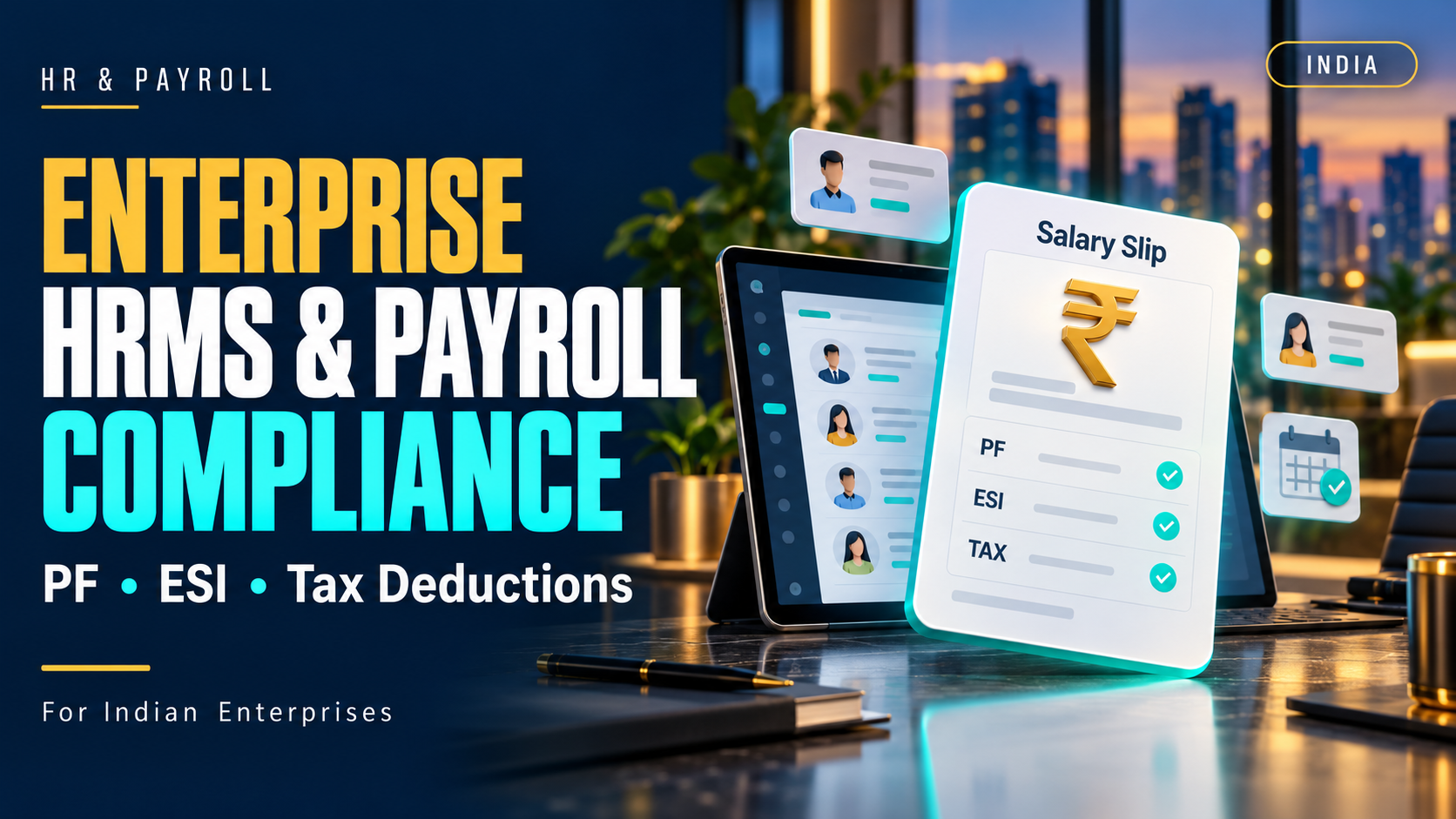
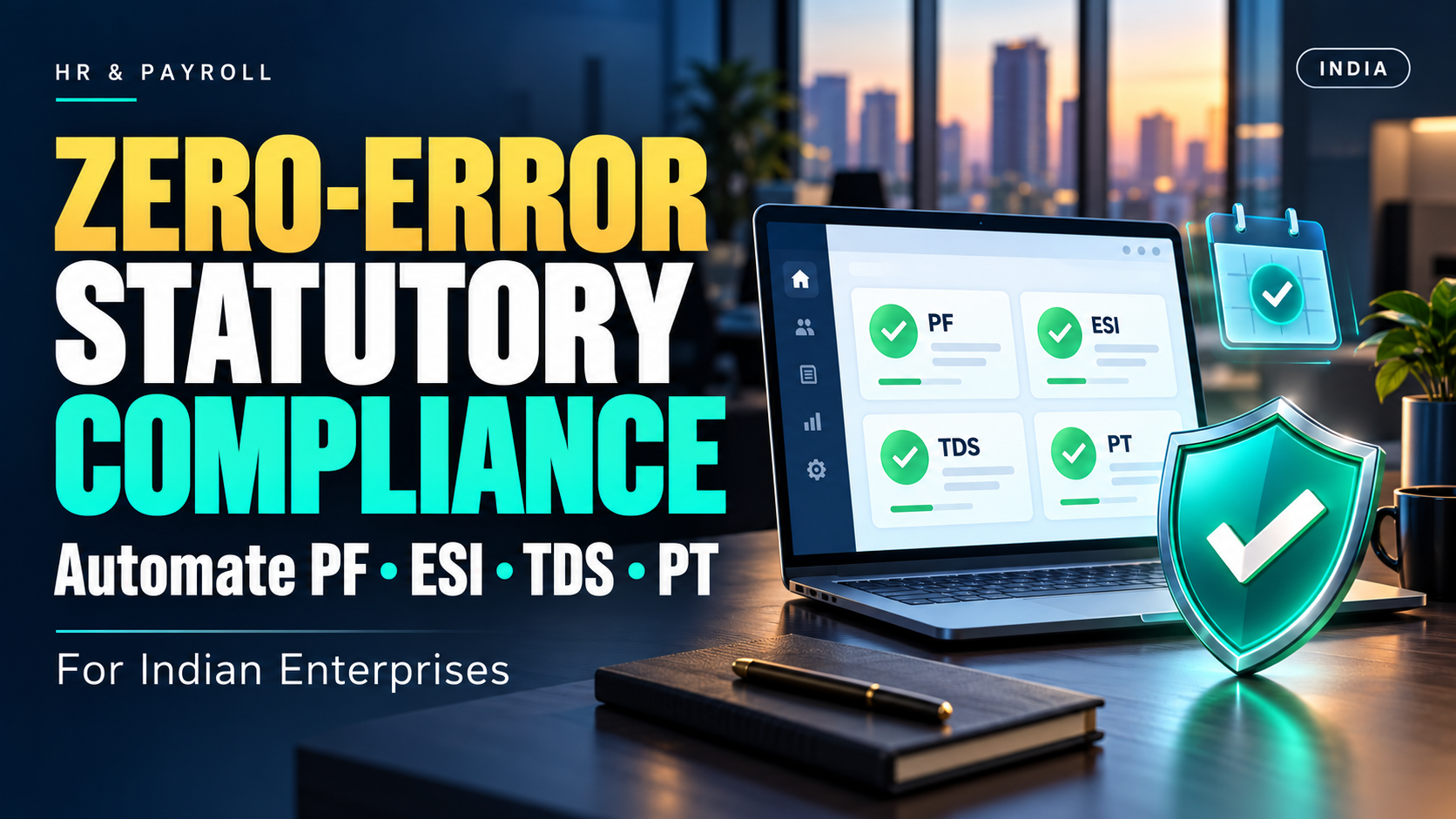
The High Cost of Manual Statutory Compliance in India
For HR Directors and CFOs in India, payroll is no longer just a transactional function; it is a critical compliance battleground. The Indian statutory landscape is notoriously complex, featuring a patchwork of central and state-level regulations that change frequently. Manual processing of Provident Fund (PF), Employee State Insurance (ESI), Tax Deducted at Source (TDS), and Professional Tax (PT) carries significant financial and reputational risks. A single calculation error or missed deadline can result in penalties, interest charges, and legal scrutiny that erode profit margins and distract leadership from strategic growth.
Traditional spreadsheet-based payroll systems are ill-equipped to handle the dynamic nature of Indian labor laws. They lack the ability to automatically adjust for wage revisions, change in tax slabs, or state-specific PT thresholds. This article provides a deep technical breakdown of these four critical statutory obligations and explains how modern, AI-driven Enterprise Resource Planning (ERP) and Human Resource Management System (HRMS) solutions are transforming compliance from a burden into a streamlined, automated process.
Decoding the Core Statutory Obligations
1. Provident Fund (PF): The Cumulative Liability
The Employees' Provident Fund and Miscellaneous Provisions Act, 1952, mandates contributions from both employers and employees. The standard rate is 12% of the Basic Salary plus Dearness Allowance (DA), capped at a wage ceiling of ₹15,000 per month. However, the complexity arises in handling 'Voluntary Employees' Provident Fund' (VFPF) and distinguishing between eligible and non-eligible employees. Manual tracking of these nuances often leads to under-contributions, which are compounded by interest penalties during audits.
2. Employee State Insurance (ESI): The Health & Wage Insurance
ESI is a social insurance scheme for employees earning up to ₹21,000 per month. The employer’s contribution is 3.25% and the employee’s share is 0.75%. The challenge for HR teams lies in the monthly eligibility check. If an employee’s basic salary crosses the threshold due to a hike, their ESI status changes, and they must be removed from the ESI register. Conversely, if they drop below, they must be added. This dynamic status tracking is nearly impossible to maintain accurately in static spreadsheets, leading to frequent non-compliance flags from the ESI Corporation.
3. Tax Deducted at Source (TDS): The Slab Complexity
TDS on salary is governed by the Income Tax Act. With the introduction of the New Tax Regime (optional) and the Old Regime, employees have choices that directly impact their monthly take-home. The system must calculate tax based on the employee’s chosen regime, considering standard deductions, exemptions, and cumulative income up to the current month. Furthermore, the shift to cumulative TDS calculation (rather than monthly) requires precise tracking of income across the financial year. Errors here lead to refund claims for employees or shortfalls for the government, both of which are operationally costly.
4. Professional Tax (PT): The State-Specific Maze
Unlike PF and ESI, which are uniform across India, Professional Tax is a state-specific levy. Each state has its own thresholds, slabs, and payment cycles (monthly, quarterly, or annual). For a company with a pan-India presence, this means managing up to 20+ different PT structures. A single employee working in a state with a high PT threshold while being paid from a hub in a low-threshold state creates a compliance minefield. Manual management of this requires a dedicated team of experts to track state-wise slabs, which is both expensive and error-prone.
The Strategic Shift: From Manual Processing to AI-Driven Automation
The solution to this complexity is not more headcount, but smarter technology. Modern HRMS and ERP platforms, such as those developed by EDUZENAI Technologies, leverage AI and rule-based engines to automate statutory compliance. Here is how enterprise-grade software addresses the specific pain points mentioned above:
Real-Time Rule Engine Updates
Leading HRMS platforms maintain a centralized, up-to-date repository of Indian labor laws. When the government announces a change in PF wage ceilings, ESI thresholds, or TDS slabs, the system updates its internal rule engine automatically. This ensures that every payroll run uses the latest parameters without manual intervention. For CFOs, this means zero risk of applying outdated rates, a common source of audit queries.
Dynamic Eligibility Tracking for PF & ESI
AI-powered systems continuously monitor employee salary structures. If an employee’s basic salary crosses the ESI threshold, the system automatically flags the change, calculates the precise month of transition, and adjusts contributions accordingly. It generates a detailed audit trail showing why an employee was excluded or included, providing robust documentation for any statutory inspection. This level of granularity is impossible to achieve manually at scale.
Automated TDS Calculation & Reconciliation
Modern HRMS platforms offer a dual-regime TDS calculator that allows employees to choose their preferred tax regime. The system then calculates cumulative TDS month-on-month, ensuring that the total tax deducted by the end of the year matches the liability. It also auto-generates Form 16 data, reducing the year-end workload for HR and Finance teams by up to 70%. For CFOs, this translates to faster closing of books and reduced external audit fees.
State-Wise PT Management
Enterprise ERP systems map each employee to their work location and apply the corresponding state’s PT rules. The system tracks monthly, quarterly, and annual PT liabilities separately, generating state-wise challans and payment schedules. This eliminates the risk of double-deduction or under-deduction, ensuring compliance across all operating jurisdictions.
Building a Compliance-First Culture with Technology
Implementing an automated HRMS is not just about software; it is about building a compliance-first culture. By integrating payroll with finance, tax, and legal modules, enterprises gain a single source of truth for all statutory data. This integration allows for real-time dashboards that show compliance health, upcoming deadlines, and potential risks. HR Directors can use these insights to proactively manage compliance, rather than reacting to issues after they arise.
Furthermore, AI-driven anomaly detection can identify irregularities in payroll data, such as duplicate payments, incorrect bank account mappings, or inconsistent statutory deductions. These alerts are sent to HR and Finance teams immediately, allowing for quick resolution before errors compound. This proactive approach significantly reduces the risk of financial leakage and regulatory penalties.
The ROI of Automated Statutory Compliance
The return on investment for automating statutory compliance is clear. First, it reduces the cost of manual processing, freeing up HR and Finance teams to focus on strategic initiatives. Second, it eliminates penalties and interest charges associated with non-compliance, which can amount to significant sums for mid-to-large enterprises. Third, it enhances employee trust and satisfaction, as accurate and timely statutory deductions lead to fewer grievances and higher retention rates.
For CFOs, the ability to predict and manage statutory liabilities with precision improves cash flow planning and financial forecasting. For HR Directors, it reduces the administrative burden and allows them to focus on talent management and organizational development. In essence, technology transforms compliance from a cost center into a strategic asset.
Choosing the Right Partner for Your Compliance Journey
When selecting an HRMS or ERP provider, it is crucial to choose a partner with deep expertise in Indian statutory compliance. Look for systems that offer configurable rule engines, real-time updates, and robust audit trails. Avoid generic global solutions that lack the granularity required for the Indian market. Instead, opt for specialized platforms that understand the nuances of PF, ESI, TDS, and PT, and can scale with your business as it grows.
EDUZENAI Technologies Private Limited offers comprehensive ERP and HRMS solutions designed specifically for the Indian enterprise landscape. Our platforms integrate AI-driven automation with deep statutory compliance expertise, ensuring that your payroll operations are not only accurate but also strategically aligned with your business goals. By partnering with us, you gain a technology-driven advantage in managing one of the most complex aspects of Indian business operations.
Key Takeaway: Statutory compliance in India is not a task to be managed; it is a risk to be mitigated through technology. By automating PF, ESI, TDS, and PT with an AI-driven HRMS, enterprises can eliminate errors, reduce costs, and build a resilient foundation for sustainable growth.