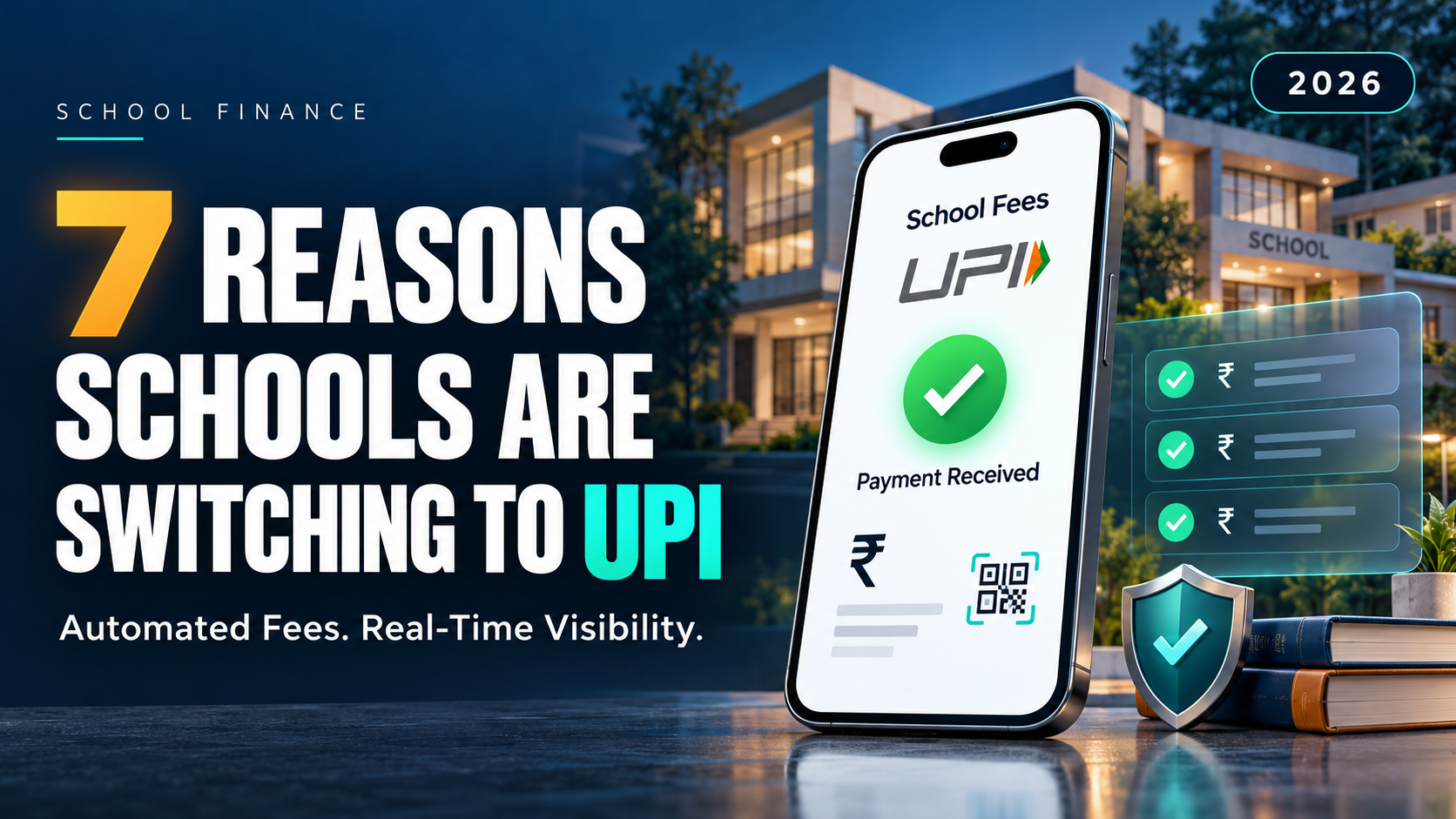
The End of Manual Reconciliation: A Strategic Imperative for 2026
For decades, the Indian education sector has operated on a hybrid model of cash, cheques, and manual bank transfers. However, the financial landscape for schools in 2026 is fundamentally different. With the Reserve Bank of India’s aggressive push for digital-first infrastructure and the maturation of the UPI (Unified Payments Interface) ecosystem, Fee Automation has shifted from a "nice-to-have" feature to a critical survival metric. For School Principals and Finance Heads, the decision to integrate a robust School ERP with automated UPI collection is no longer just about accepting payments; it is about eliminating operational debt, preventing revenue leakage, and leveraging data for strategic growth.
As we look at the current market trends, institutions that have adopted automated fee systems are reporting a 40-60% reduction in administrative overheads and a near-zero rate of payment reconciliation errors. This article breaks down the seven critical reasons driving this massive shift.
1. Elimination of Revenue Leakage and Fraud
Manual fee collection is inherently prone to human error and, more dangerously, internal fraud. In traditional setups, fees are collected by ground staff, recorded in physical registers, and then deposited into the bank. This gap between collection and deposit creates a "black hole" where money can go missing. In 2026, with the complexity of partial payments, installments, and waivers, manual tracking is virtually impossible to audit effectively.
Automated UPI collection ensures that every rupee is digitally tracked from the moment of intent to the moment of settlement. The School ERP system directly triggers the payment gateway, and the success confirmation is recorded instantly against the student’s ledger. There is no physical cash to misplace, no register to alter, and no delay in posting. For Finance Heads, this provides an immutable audit trail that satisfies both internal compliance and external auditor requirements with minimal effort.
2. Real-Time Cash Flow Visibility for Strategic Planning
One of the biggest pain points for school administrators is the lag in financial reporting. In manual systems, you might not know the actual fee recovery percentage for the month until the bank statement is processed, often weeks after the fact. This lag hampers the ability to make timely decisions regarding vendor payments, staff salaries, and capital expenditures.
With automated UPI integration, the School ERP provides a live dashboard of fee collections. Principals can see, in real-time, how much has been collected, how much is pending, and which classes or sections are lagging. This real-time data allows for proactive intervention. If a specific batch of parents is delayed, targeted communication can be triggered immediately rather than waiting for month-end reports. This agility in cash flow management is a strategic advantage that manual systems simply cannot offer.
3. Reduction of Administrative Overhead and Staff Burnout
Behind every manual fee collection process is a significant amount of human labor. Staff spend hours verifying bank statements, matching transaction IDs with student IDs, and updating spreadsheets. This repetitive, low-value work drains the productivity of finance teams who should be focusing on strategic financial planning and compliance.
Automated UPI fee collection removes this burden entirely. The system automatically matches transactions with student records and updates the ledger. This frees up finance staff to focus on high-value tasks such as budget forecasting, vendor negotiation, and financial analysis. In 2026, where talent retention in the education sector is a challenge, reducing the monotony of manual data entry is a key factor in keeping your finance team engaged and effective.
4. Enhanced Parent Experience and Reduced Friction
Parents today are digital natives who expect seamless, app-based experiences. Asking them to visit the school office, fill out paper forms, or make cheques is an outdated practice that creates friction and frustration. When the payment process is difficult, parents delay payments, leading to higher default rates.
Automated UPI collection offers a frictionless experience. Parents can pay fees via their preferred UPI apps (GPay, PhonePe, Paytm, etc.) from their smartphones, at any time, from anywhere. The School ERP sends automated reminders via SMS or email, linking directly to a secure payment page. This convenience not only improves the parent experience but also increases the speed of payment, reducing the average days sales outstanding (DSO). A smoother payment process leads to higher satisfaction scores and stronger parent-school relationships.
5. Automated Dunning and Reduced Default Rates
Fee defaults are a persistent challenge for Indian schools, with some institutions reporting default rates of 5-10% annually. In manual systems, follow-ups are often inconsistent, relying on the memory and initiative of individual staff members. This leads to missed opportunities for recovery and a growing backlog of unpaid dues.
Modern School ERP solutions with UPI integration include intelligent dunning engines. These systems automatically send personalized reminders to parents as due dates approach. If a payment is missed, the system escalates the communication, sending more urgent reminders and, if necessary, triggering alerts to the principal or class teacher. This consistent, automated follow-up significantly reduces default rates and ensures that fees are collected on time. In 2026, the ability to automate the dunning process is a key differentiator for schools looking to improve their financial health.
6. Data-Driven Insights for Financial Forecasting
Manual fee collection generates data, but it is often siloed in spreadsheets and bank statements, making it difficult to analyze. In contrast, automated UPI collection generates rich, structured data that can be leveraged for advanced analytics. The School ERP can track payment trends, identify patterns in default behavior, and forecast future cash flows with high accuracy.
For example, the system can analyze which payment methods are most popular among parents, which days of the week see the highest payment activity, and which classes have the highest default rates. This data can be used to optimize payment processes, target specific segments for outreach, and make more accurate financial forecasts. In 2026, data-driven decision-making is a hallmark of successful educational institutions, and automated fee collection is a key enabler of this shift.
7. Scalability and Future-Proofing for Growth
As schools grow, the complexity of fee collection increases. Adding new classes, sections, or campuses can strain manual systems, leading to errors and inefficiencies. Automated UPI collection, on the other hand, scales effortlessly. Whether your school has 500 or 5,000 students, the system can handle the volume with ease.
Furthermore, automated systems are future-proof. As the UPI ecosystem evolves, with new features like credit line UPI and international UPI, the School ERP can be updated to support these new capabilities without disrupting operations. This scalability and adaptability are critical for schools looking to expand their footprint and remain competitive in the evolving education landscape of 2026.
Conclusion: The Strategic Advantage of Automation
The shift to automated UPI fee collection is not just a technological upgrade; it is a strategic transformation. By eliminating revenue leakage, improving cash flow visibility, reducing administrative overhead, enhancing the parent experience, automating dunning, leveraging data insights, and ensuring scalability, schools can achieve a significant competitive advantage. In 2026, the question is no longer whether to adopt automated fee collection, but how quickly you can implement it to unlock its full potential.
For School Principals and Finance Heads, the time to act is now. By partnering with a leading School ERP provider like EDUZENAI, you can ensure a seamless transition to automated UPI fee collection, positioning your institution for financial success and operational excellence in the years to come.